
Fast Commercial Espresso Repair in Portland

Table of Contents
When Your Espresso Machine Goes Down: Why Speed Matters
Commercial Coffee Machine Troubleshooting Guide: Before You Call
Machine won't power on
No water pressure or weak extraction
Steam wand not steaming
Leaks from the group head or boiler
Commercial Espresso Machine Maintenance Schedule: Prevention Over Crisis
Daily cleaning and backflushing
Weekly deep cleaning and descaling
Monthly professional inspections
What to Expect from On-Site Commercial Espresso Machine Service
Espresso Machine Repair Cost Estimate: Understanding Your Investment
Choosing Between Repair and Replacement for Commercial Equipment
Minimizing Downtime During Peak Hours
Frequently Asked Questions
Last Updated: October 7, 2026
When Your Espresso Machine Goes Down: Why Speed Matters
A broken espresso machine during the morning rush means lost revenue, frustrated customers, and a staff scrambling to improvise. At Highpockets Coffee, we know every idle minute is a customer walking out the door.
That's why fast commercial espresso repair matters more than most cafe owners realize. When you need commercial espresso machine service, you need it now, not next week.
A service that arrives in hours versus days is the difference between a manageable disruption and a crisis. This guide covers troubleshooting before you call a technician and what to expect from a fast, reliable repair partner.
Commercial Coffee Machine Troubleshooting Guide: Before You Call
Not every espresso machine problem requires immediate professional help. Some issues you can diagnose yourself while waiting for a technician; others demand expert hands immediately. Knowing the difference saves time and money.
Machine won't power on
A machine that won't turn on feels catastrophic, but the cause is often simple. Check that the outlet works by plugging in another device, verify the power switch is on, and check whether the machine tripped a breaker.
If power reaches the machine but it still won't start, you're likely looking at an internal electrical fault. This requires professional diagnosis. Don't force the power button repeatedly or attempt to open the machine yourself. Call for commercial espresso repair service at this point.
No water pressure or weak extraction
Weak water pressure is one of the most common issues in commercial espresso machines. Before calling a technician, confirm water is flowing and that the shut-off valve near the water line is fully open.
Next, backflush the group head if your machine allows it (skip this if you're unfamiliar and let a professional handle it). If the pump is completely silent, it may have failed.
Low pressure often points to a clogged water filter, failing pump, or scale buildup in the boiler. These need professional attention, but knowing what's happening helps the technician diagnose faster.
Steam wand not steaming
A steam wand producing no or weak steam usually means the steam line is blocked. Run water through the wand for a few seconds, then try steaming again to clear minor blockages.
If that fails, soak the wand tip in hot water with espresso cleaning solution for 15 minutes, then carefully clear the steam hole with a small wire. Never force anything, the opening is delicate.
If the wand still produces no steam after cleaning, the issue is internal: a blocked steam line or failed steam boiler. This requires a technician.
Leaks from the group head or boiler
Water dripping from the group head usually means the group gasket has worn out. The rubber seal costs little but requires disassembly, so this is a job for a professional.
Leaks from the boiler are more serious. A small weep from the bottom drain valve is normal, but steady dripping from the boiler body suggests a crack or failed seal. Stop using the machine and call for commercial espresso machine service immediately, since operating a leaking boiler risks damage and safety hazards.
Commercial Espresso Machine Maintenance Schedule: Prevention Over Crisis
Preventive maintenance is the difference between a machine that lasts 10 years and one that fails after 3. A solid schedule catches small problems before they become expensive breakdowns, yet many cafe owners cut corners and regret it later.
Daily cleaning and backflushing
Every day your machine operates, coffee residue and mineral deposits build up inside the group head and portafilter, degrading extraction quality and accelerating wear.
Backflushing, running water backward through the group head without the portafilter, clears loose debris. Do this 5-10 times daily between rushes; it takes 30 seconds and significantly extends your group gasket's life.
Purge the group head before each shot and wipe the gasket with a damp cloth. These tiny habits compound into years of reliable performance.
Weekly deep cleaning and descaling
Once a week, remove the shower screen and dispersion plate and soak them in hot water with espresso cleaning powder for 15 minutes. Scrub gently, rinse thoroughly, and reinstall.
Descaling the boiler removes mineral buildup that reduces heat transfer and strains the heating element. Use a commercial descaling solution per the manufacturer's instructions; this takes 30-45 minutes and should happen weekly in hard water areas, monthly in softer ones.
Neglecting descaling is one of the fastest ways to shorten a machine's lifespan. Scale buildup forces the heating element to work harder, generates inconsistent temperatures, and eventually causes boiler failure.
Monthly professional inspections
Even with diligent daily and weekly care, a machine needs professional eyes monthly. A technician inspects the pump, water pressure, heating element, temperature stability, and the condition of seals and gaskets.
These inspections catch problems before they cause downtime. A worn gasket spotted early costs $50 to replace; left until it fails, it can damage the group head and cost ten times as much. At Highpockets Coffee, we recommend monthly inspections for any commercial espresso machine running more than 30 hours per week.
What to Expect from On-Site Commercial Espresso Machine Service
When your machine fails during service, you need a technician who arrives fast and diagnoses accurately. On-site service means the work happens in your cafe, so your machine stays where it belongs.
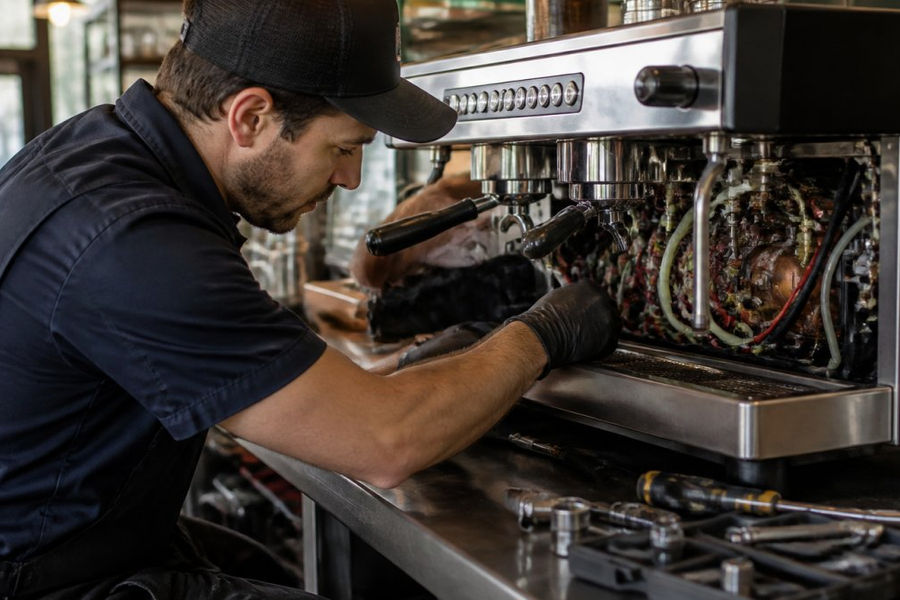
A technician arriving for on-site commercial espresso repair service should start with a clear diagnostic process, asking what happened, when it started, and what you've already tried.
Next comes visual inspection: checking power, water supply, and the exterior for damage, then running the machine through its cycles. A good technician can often identify the issue within 10-15 minutes.
Once diagnosed, they explain what needs to happen, whether a simple adjustment, part replacement, or something more complex, and give you a realistic timeline including any parts orders.
For urgent repairs like a broken pump, failed heating element, or severe leak, a fast service partner has common replacement parts on hand, so the repair happens the same day. That's the difference between an hour of downtime and a day or more.
Professional technicians also work around your schedule, often repairing machines during slower periods or after hours, then cleaning up and testing thoroughly before leaving.
Espresso Machine Repair Cost Estimate: Understanding Your Investment
Repair costs vary widely depending on what fails. Understanding the range helps you budget and decide between repair and replacement.
A simple adjustment or cleaning typically runs between a diagnostic fee and a minor service charge. Descaling or a gasket replacement is modest: the gasket is inexpensive but requires labor to access.
More serious repairs, like a failed pump, heating element replacement, or boiler repair, cost significantly more. A pump replacement might take 2-3 hours of labor; boiler repair is even more involved.
The diagnostic fee is usually credited toward the repair if you proceed. Some partners charge flat rates for common repairs, others hourly labor plus parts, so ask upfront about pricing.
The real question is whether repair makes sense compared to replacement. A 15-year-old machine with a failed boiler might cost more to fix than it's worth, while a newer machine with a single failed component is usually worth repairing.
Choosing Between Repair and Replacement for Commercial Equipment
At some point, every cafe owner faces this decision: fix the machine or buy a new one?
The answer depends on the machine's age, repair cost, and how long you plan to keep it. A 5-7 year old machine with a failed component is almost always worth repairing: parts are available and you get years more service.
A machine 12+ years old with a major failure, especially a boiler or pump, may be nearing the end of its economic life. Repair costs can approach or exceed a used replacement's value, so upgrading often makes more sense.
Consider reliability too. A machine needing multiple repairs in the last two years is showing its age, and each fix is temporary until the next failure.
New equipment comes with warranties, modern features, and improved efficiency. Refurbished machines from a trusted source like Highpockets Coffee offer a middle ground: newer technology at a lower cost, inspected and tested before sale.
Minimizing Downtime During Peak Hours
When your espresso machine fails during the morning rush, you need a strategy to keep running while waiting for repair.
First, have a backup plan: some cafes keep a smaller manual machine for emergencies, others partner with a neighboring cafe for overflow. Know your options before crisis hits.
Second, communicate immediately with your team and customers. A simple counter sign explaining the situation and offering alternatives like pour-over or cold brew manages expectations.
Third, call your service partner immediately and explain you're in peak hours. Most fast commercial espresso repair services prioritize emergency calls during business hours.
Fourth, document the failure: the time it started, what you were doing, and what went wrong. This helps the technician diagnose faster and gets you back online sooner.
Finally, use downtime for other work: clean equipment, prep for the next rush, or handle administrative tasks. It's frustrating, but an opportunity to catch up.
When your espresso machine fails, speed and expertise matter equally. A fast commercial espresso repair service that misdiagnoses wastes your time; a thorough technician who takes three days to arrive costs you revenue.
Highpockets Coffee delivers on-site commercial espresso machine service backed by deep expertise in Nuova Simonelli equipment and other commercial machines.
Issue | Quick Fix | Professional Service |
Machine won't power on | Check outlet, circuit breaker | Electrical fault diagnosis |
Weak water pressure | Clear filters, backflush | Pump or boiler inspection |
Steam wand blocked | Clean tip, soak in solution | Internal steam line clearing |
Leaks from group head | None, requires service | Gasket replacement |
Leaks from boiler | Stop using machine | Boiler seal or crack repair |
Pro Tip Keep a log of your machine's performance. Note when you last descaled, when you replaced gaskets, and any service calls. This history helps technicians understand your machine's maintenance pattern and catch emerging problems faster.
Watch Out Never attempt to open a pressurized boiler or disassemble internal components yourself. Steam and hot water under pressure can cause serious burns. Even small mistakes can damage expensive parts or create safety hazards. Leave internal work to professionals.
According to the Specialty Coffee Association's equipment maintenance guidelines, regular preventive maintenance extends commercial espresso machine lifespan by 40-60% compared to machines serviced only after failure. The investment in monthly inspections and weekly descaling pays for itself in reduced emergency repairs and extended equipment life.
For cafes in the Pacific Northwest, the National Coffee Association's water quality standards recommend regular water testing and filtration to prevent mineral buildup that accelerates boiler wear.
Fast commercial espresso repair in Portland starts with choosing a service partner who understands both the urgency of downtime and the precision required for proper diagnosis. Your machine is the heart of your business.
Frequently Asked Questions
How fast can you get someone out for a commercial espresso machine repair in Portland?
Response times depend on the severity of the issue and current service demand. Emergency repairs during morning rush hours are prioritized. Contact Highpockets Coffee directly for current availability and same-day service options. Most commercial clients receive diagnosis and initial troubleshooting support within hours of reporting an issue.
What does a typical commercial espresso machine maintenance schedule look like?
Daily backflushing and purging, weekly deep cleaning and descaling, and monthly professional inspections form the foundation of a solid maintenance schedule. For high-volume commercial operations, quarterly professional servicing prevents most common failures. Preventive maintenance helps reduce emergency repairs and extends machine life.
What's the typical espresso machine repair cost estimate for commercial machines?
Repair costs vary based on the fault, machine model, and whether parts need replacement. Diagnostic fees apply to identify the issue, while labor and parts determine final cost. Simple fixes like descaling or seal replacement cost less than boiler repairs or pump replacement. Request a quote from Highpockets Coffee for accurate pricing based on your specific machine and repair needs.
Should I repair my commercial espresso machine or replace it?
Repair is often a good choice if your machine is less than 10 years old. Newer Nuova Simonelli machines with good maintenance records typically justify repair. However, if downtime is frequent, parts are obsolete, or the machine is over 12 years old, replacement may make business sense. Highpockets Coffee can assess your machine and recommend the most cost-effective path forward.
Request A Quote


Comments